

Your child brings home a good NAPLAN result. You feel relieved. But then you notice something that doesn’t quite add up. They struggle to remember multiplication facts. They get confused by fractions. A simple word problem leaves them frustrated. Or they can get the right answer—but can’t explain how they got there.
Could your child still have a math learning gap even with a good NAPLAN result?
The answer is yes.
NAPLAN can provide a useful snapshot of a student’s numeracy performance, but one test cannot show everything about how a child understands and applies math. A child may perform well on familiar questions while still having gaps in foundational skills that can affect future learning.
And these gaps don’t always announce themselves with a poor grade.
Sometimes they’re hidden in the small things parents see every day.
In this post, we’ll look at 7 signs of a possible math learning gap, explain what parents should look for in both primary and secondary school, and show how a free MathDingo math assessment can help you get a clearer picture of your child’s strengths and areas that may need support.
Let’s start with the first sign—because it is one many parents don’t notice.
What Is a Math Learning Gap?
A math learning gap is a missing or underdeveloped mathematical skill that can make future learning more difficult.
It could involve something as basic as place value or multiplication facts, or something more advanced such as fractions, algebra, mathematical reasoning, or problem-solving.
Math skills build on one another. If a child doesn’t fully understand one concept, the next concept can feel much harder.
For instance, a student who hasn’t developed a strong understanding of multiplication may later struggle with division, fractions, percentages, and algebra.
A math learning gap does not mean a child is bad at math. It means there may be a particular skill or concept that needs more attention.
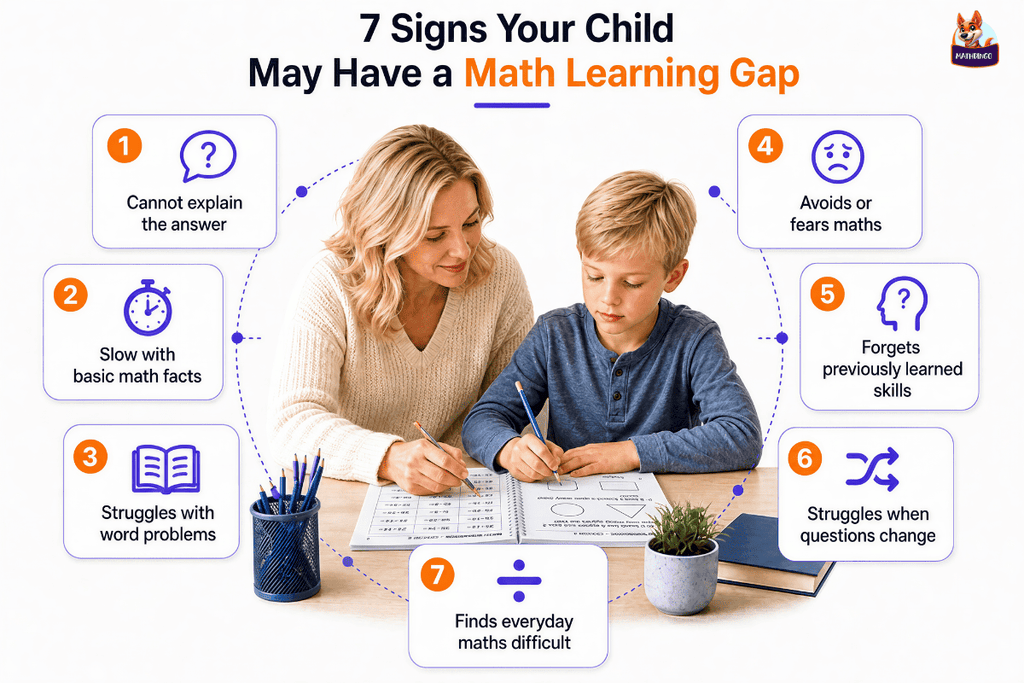
7 Signs Your Child May Have a Math Learning Gap
1. Your Child Can Get the Answer but Can’t Explain It
Try asking your child a simple question: “How did you work that out?”
If they regularly know the answer but cannot explain their thinking, it may be worth taking a closer look.
For example, a child may know that 7 × 6 = 42 because they’ve memorized the multiplication fact. But can they explain what multiplication means? Can they solve a similar problem when the numbers change? Can they use multiplication in a real-life situation?
Understanding the reasoning behind an answer becomes increasingly important as students move into more advanced math.
A child who understands the concept can usually approach a problem in more than one way. A child who has memorized a procedure may become stuck when the question looks different.
2. Basic Math Facts Take Too Long
Every child needs time to develop math fluency. But if simple calculations consistently take a long time, it may indicate that some foundational skills aren’t secure yet.
Watch for things like:
- Counting on fingers for basic calculations
- Difficulty recalling multiplication facts
- Using a calculator for very simple problems
- Taking a long time to complete basic addition or subtraction
- Forgetting facts that were previously learned
Why does this matter?
When basic calculations become more automatic, children can focus their attention on the bigger problem.
A student who is using most of their mental effort to work out 8 × 7 has less capacity available to think about a multi-step problem involving fractions or algebra.
3. Word Problems Are Much Harder Than Straight Calculations
This is an easy sign to miss.
Your child may correctly solve: 24 ÷ 6 = 4.
But when you ask, “24 cookies are shared equally among 6 children. How many cookies does each child get?” they aren’t sure what to do.
The calculation itself isn’t necessarily the problem.
The difficulty may be understanding the situation, identifying the relevant information, deciding which operation to use, and connecting the words to the mathematics.
This is why math problem-solving skills are just as important as calculation skills.
If your child regularly performs well on straightforward calculations but struggles with word problems, it may be worth investigating their mathematical reasoning and ability to apply concepts.
4. Your Child Avoids Math or Gets Frustrated Quickly
Sometimes a child’s attitude toward math tells you something their test results don’t.
Does your child:
- Put off math homework?
- Give up after one difficult question?
- Become upset when they make a mistake?
- Say, “I’m just not good at math”?
- Avoid answering questions because they’re afraid of being wrong?
Not every child enjoys math, and occasional frustration is completely normal.
The concern is a persistent pattern.
Repeated difficulty can affect confidence. Over time, a child may begin avoiding math because they expect to struggle before they even start.
That doesn’t mean the problem is simply motivation. Sometimes confidence drops because a foundational concept was never fully understood.
Finding the source of the difficulty is more useful than simply telling a child to “try harder.”
5. Previously Learned Skills Keep Disappearing
Does your child seem to understand a topic one month and struggle with it again later?
Perhaps they learned fractions successfully but have difficulty with them when they reappear in a new topic.
Or they learned multiplication facts but still have trouble recalling them months later.
This can happen when a concept has been memorized without becoming fully understood or practiced.
It can also happen when a child moves forward before the foundation underneath a skill is secure.
Instead of repeatedly practicing the same worksheet, it may be more helpful to ask: “What part of this concept does my child not fully understand yet?”
That question can lead to much more targeted support.
6. Your Child Can Solve Familiar Questions but Struggles When They Change
Here’s a simple way to spot this.
Your child solves: 25 + 37 = 62 without a problem.
But when the question becomes: “Emma has 25 stickers and receives 37 more. How many stickers does she have altogether?” they suddenly don’t know which operation to use.
The numbers haven’t really changed. The presentation has.
This can indicate that your child has learned a procedure but is still developing the ability to apply the underlying concept independently.
Math isn’t only about remembering steps. Students also need to recognize when and why to use those steps.
That ability becomes particularly important in secondary school, where problems often combine several mathematical concepts.
7. School Results Look Fine, but Everyday Math Is Difficult
Some math difficulties don’t appear on a test. They appear at home.
Your child might struggle to:
Work out change when shopping
Estimate how much something weighs
Read an analog clock
Compare prices
Understand measurements
Use fractions in everyday situations
Decide whether an answer makes sense
Explain their mathematical thinking
These situations can tell you how comfortably your child applies math outside a classroom exercise.
That’s important because math achievement is broader than a single test score.
Can a Child Have a Math Learning Gap Even If Their NAPLAN Result Is Good?
Yes.
NAPLAN provides useful information about student achievement, but it isn’t a complete diagnostic assessment of every mathematical skill.
A child can perform well in a standardized assessment while still having a specific area that needs attention.
Parents can build a clearer picture by considering several things together:
- NAPLAN performance
- Classroom work
- Teacher feedback
- Homework
- Problem-solving
- Mathematical reasoning
- Everyday math skills
- Confidence
- Ability to retain previously learned concepts
Think of NAPLAN as one piece of information, rather than the complete picture of your child’s math ability.
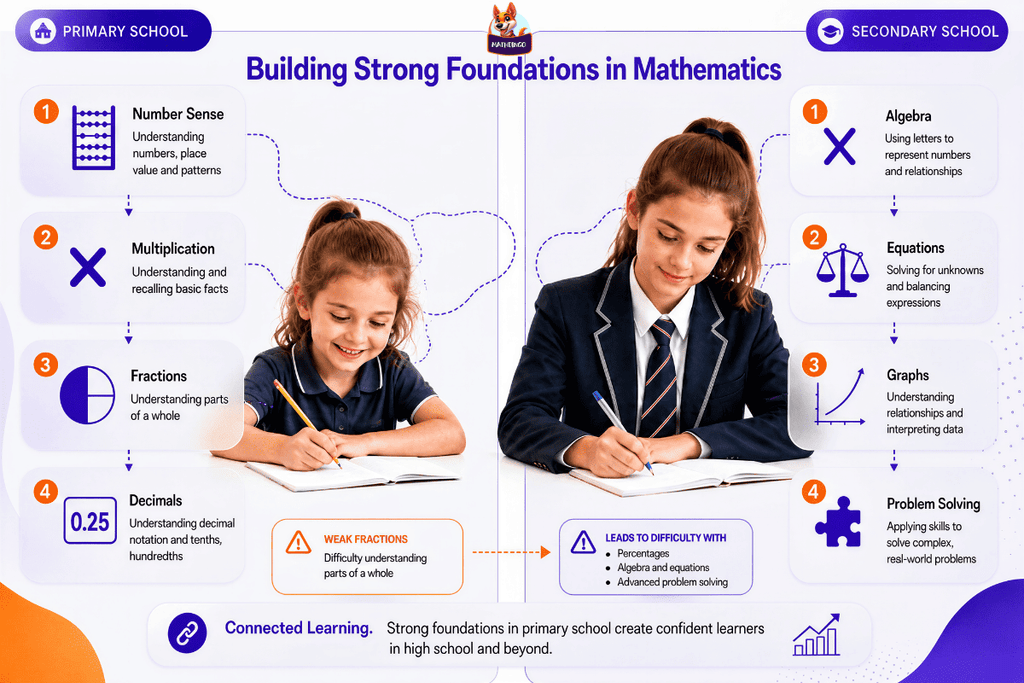
Math Learning Gaps in Primary School
In primary school, math learning gaps often involve foundational skills.
Parents may notice difficulty with:
- Number sense
- Place value
- Addition and subtraction
- Multiplication and division
- Fractions
- Decimals
- Measurement
- Geometry
- Word problems
These skills matter because later mathematics builds on them.
A child who hasn’t developed a strong understanding of fractions, for example, may find decimals, percentages, ratios, and later algebra more difficult.
That’s why early identification can be valuable.
Math Learning Gaps in Secondary School
Math becomes more abstract and interconnected in secondary school.
A student may struggle with:
- Fractions and percentages
- Ratio and proportion
- Algebra
- Equations
- Graphs
- Geometry
- Statistics
- Measurement
- Multi-step problem-solving
- Mathematical reasoning
Sometimes the apparent problem isn’t actually the current topic.
A student struggling with algebra may have an earlier gap involving fractions, negative numbers, multiplication, or basic operations.
Simply giving the student more algebra practice may not address the underlying issue.
The first step is understanding where the difficulty starts.
How Can MathDingo’s Free Math Assessment Help?

If you’re asking, “How do I find out what math skills my child is struggling with?”, a targeted assessment can be a useful starting point.
The MathDingo Free Math Assessment is designed to help parents get a clearer picture of their child’s math skills and identify areas that may need additional attention.
Rather than simply asking whether a child is “good at math,” an assessment can help answer more useful questions:
- What does my child already understand?
- Which areas appear stronger?
- Where might additional support be useful?
- Are there foundational skills that need attention?
Identify Potential Areas of Difficulty
A targeted assessment can provide insight into areas such as number skills, calculation, problem-solving, and mathematical reasoning.
This gives parents a more specific starting point than simply knowing that a child is “struggling with math.”
Understanding the particular skill that needs attention can make future practice more focused.
See Strengths as Well as Gaps
Assessment isn’t only about finding weaknesses.
Knowing what your child already understands matters too.
Strong areas can be reinforced, while areas that need more support can receive additional attention.
That can create a more positive learning experience and help children build confidence instead of feeling that they are simply “behind.”
Take Action Before a Small Gap Becomes a Bigger One
Parents don’t necessarily need to wait for a major drop in grades before investigating a concern.
If you consistently notice difficulty with a particular area of math, getting more information can help you decide what to do next.
You can discuss your concerns with your child’s teacher and use assessment information as another piece of the puzzle.
Not sure where your child may be struggling with math? Try the MathDingo Free Math Assessment for a clearer starting point.
What Should Parents Do If They Notice These Signs?
Seeing one of these signs doesn’t automatically mean your child has a learning gap.
Instead, look for patterns that continue over time.
Start with three practical steps.
1. Look for Repeated Difficulties
One wrong answer is normal.
Repeated difficulty with the same type of skill is more meaningful.
2. Identify the Underlying Skill
Try to work out whether the problem involves multiplication, fractions, number sense, problem-solving, reasoning, or another foundational concept.
3. Get Appropriate Support
Talk with your child’s teacher and consider a targeted math assessment if concerns continue.
The goal isn’t to put a label on your child. It’s to understand what they need to move forward with greater confidence.
FAQ
Final Thoughts
A good NAPLAN result is encouraging, but it doesn’t necessarily mean your child’s math skills are strong in every area.
The more useful question is: “Does my child understand the math they’re learning, and can they apply it independently?”
Pay attention to repeated difficulty with basic skills, word problems, mathematical reasoning, unfamiliar questions, and everyday math.
If you notice a pattern, don’t wait for the problem to become overwhelming.
A targeted assessment can help you understand where your child is now and give you a clearer starting point for deciding what support may be helpful. Think your child may have a math learning gap? Start with the MathDingo Free Math Assessment and take the first step toward understanding their math skills.
Have a Question?
Leave your details below and our team will get back to you.