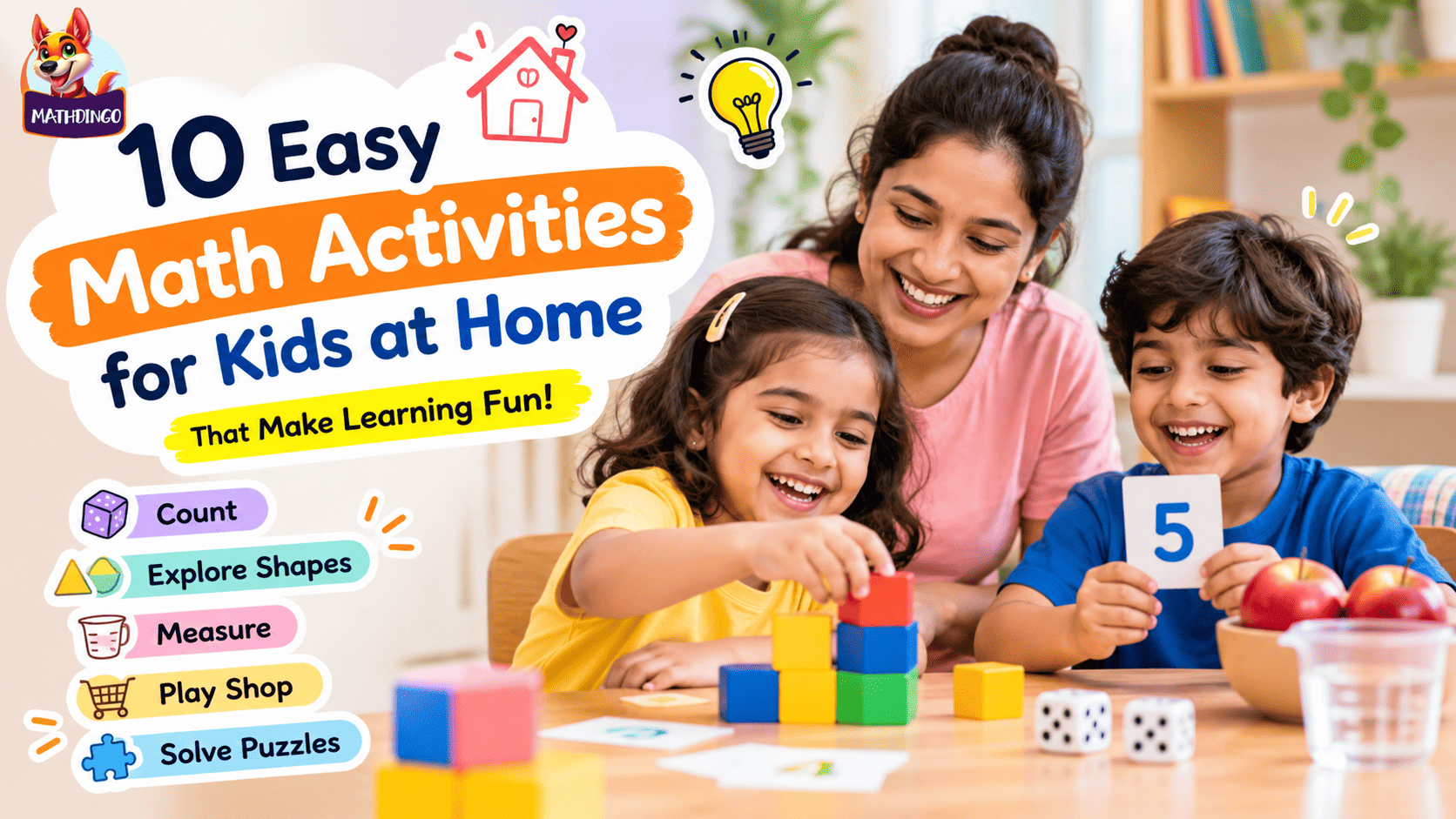
Does your child sometimes say, “I don’t like maths”? You’re not alone! Many children find mathematics difficult when it involves only textbooks, calculations, and worksheets. But what if they could learn maths while playing with their favourite toys, helping you in the kitchen, or pretending to run a grocery shop?
The good news is that learning doesn’t have to stop when children leave the classroom. With a few simple ideas, parents can introduce fun math activities for kids at home without spending a lot of money on learning materials.
Here are 10 simple activities you can try with your child to make everyday learning more enjoyable.
Why Should Parents Encourage Math Learning at Home?
Children often understand mathematical concepts better when they can see and experience them in real life. For example, counting apples while arranging groceries is much easier to understand than simply looking at numbers on a page.
Regular practice at home also helps children develop number sense, logical thinking, problem-solving abilities, and confidence. Most importantly, it shows them that maths is useful in everyday life, not just something they study at school.
10 Fun Math Activities for Kids at Home
1. Turn Everyday Objects into Counting Tools
You don’t need special toys to teach your child how to count. Look around your home. Buttons, spoons, fruits, and building blocks can all become useful learning materials.
Ask your child to count five apples, arrange ten blocks in a row, or divide eight buttons into two equal groups. Once they get comfortable, introduce simple addition and subtraction.
What children learn: Counting, number recognition, addition, and subtraction.
2. Make Number Matching a Game
Some children enjoy learning numbers more when they have something to touch and move around. Write numbers on small paper cards and ask your child to match each card with the correct number of objects.
For instance, place the number 4 card beside four toy cars. You can make the game more interesting by setting a time challenge or asking your child to arrange the numbers in order.
MathDingo’s flashcards can also be a useful addition to these activities.
What children learn: Number recognition, sequencing, and number sense.
3. Let Your Child Help in the Kitchen
The next time you’re preparing a meal, invite your child to help. Ask them to count the potatoes, measure a cup of flour, or add two spoonfuls of sugar.
Older children can even learn simple fractions. Show them what half a cup or a quarter of a fruit looks like.
It’s a lovely way to spend time together while introducing practical mathematics.
What children learn: Counting, measurement, fractions, and basic arithmetic.
4. Go on a Shape Hunt Around the House
Here’s a simple game that can keep children busy while teaching them geometry. Ask them to find objects around the house that look like different shapes.
A wall clock might be a circle, a book might be a rectangle, and a sandwich might look like a triangle. Let children draw the objects and identify their shapes.
What children learn: Shape recognition, geometry, and spatial awareness.
5. Teach Addition and Subtraction Using Toys
Children’s favourite toys can become excellent math teaching tools. Place four toy cars in front of your child and add two more. Ask how many cars there are now.
You can also remove a few toys and ask how many are left. These small challenges make basic calculations easier to understand because children can actually see what is happening.
What children learn: Addition, subtraction, and problem-solving.
6. Create Your Own Math Board Game
A rainy afternoon is a perfect opportunity to create a simple board game together. Draw numbered boxes on a sheet of paper, use a dice, and let your child move a playing piece according to the number rolled.
You can introduce simple addition by using two dice. For children who enjoy strategic games, MathDingo’s Memory Chess offers another interesting way to encourage concentration and thinking skills.
What children learn: Counting, addition, sequencing, and logical thinking.
7. Measure Things Around Your Home
Give your child a measuring tape or ruler and ask them to measure their favourite book, a table, or a toy. Then compare the measurements.
Ask questions such as, “Which object is longer?” or “Is your school bag heavier than this cushion?” These little conversations help children understand measurements without needing a formal lesson.
What children learn: Measurement, comparison, estimation, and mathematical reasoning.
8. Create Colourful Patterns with Blocks
Take a few colourful building blocks, beads, or buttons and arrange them in a repeating pattern. For example, red, blue, red, blue.
Ask your child what colour should come next. Once they understand the idea, introduce slightly more challenging patterns or simple number sequences such as 2, 4, 6, and 8.
What children learn: Pattern recognition, sequencing, and logical reasoning.
9. Play Shopkeeper and Customer
Children love pretending to be adults, so why not turn that interest into a learning activity?
Set up a small grocery shop using household items. Give each item a pretend price and provide your child with play money. Let them choose products, calculate the total, and work out how much money they have left.
It’s a fun way to introduce money and everyday calculations.
What children learn: Addition, subtraction, money management, and practical problem-solving.
10. Spend Time Solving Math Puzzles Together
Not every math activity needs to involve counting or calculations. Number puzzles, riddles, and brain teasers are great ways to encourage children to think independently.
Start with simple puzzles and gradually introduce more challenging ones. Rather than immediately telling your child the answer, give them time to think and try different approaches.
For additional learning resources, MathDingo’s Complete Learning Kit – 2 brings together two workbooks, flashcards, an LCD writing panel, Memory Chess, and an Edu Roller.
What children learn: Critical thinking, concentration, memory, and problem-solving.
Explore Math Learning Kits for Kids by MathDingo
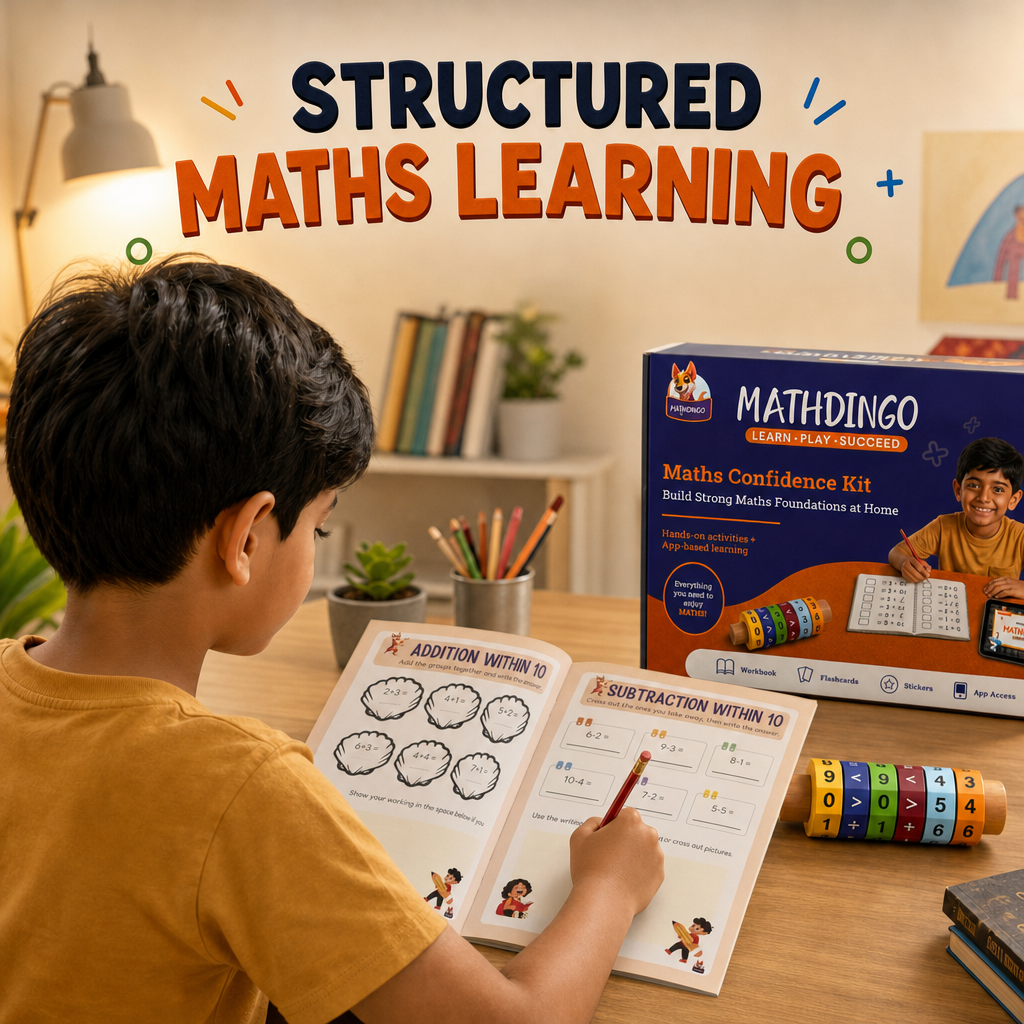
Sometimes, parents want a little extra support to make learning more organised and engaging. That’s where educational resources can help.
MathDingo offers three learning kits for children:
- Early Learner Kit – Maths (₹1,199): Comes with a workbook, flashcards, LCD writing panel, stickers, magnetic box, and three months of free app access.
- Interactive Learning Kit – 1 (₹1,599): Includes a workbook, flashcards, LCD writing panel, Memory Chess, and free app access.
- Complete Learning Kit – 2 (₹2,299): Includes two workbooks, flashcards, LCD writing panel, Memory Chess, Edu Roller, and free app access.
These resources offer different ways to complement everyday learning and give children more opportunities to practise.
A Few Tips to Make Math Learning Easier
- Choose activities that match your child’s age and abilities.
- Keep learning sessions short so children don’t lose interest.
- Connect mathematical concepts with everyday experiences.
- Let children make mistakes and figure things out independently.
- Appreciate their efforts instead of focusing only on correct answers.
- Most importantly, make learning enjoyable rather than a daily task they feel forced to complete.
FAQ
Counting household objects, number matching, cooking, shape hunts, pretend shopping, and solving puzzles are easy activities parents can try.
Connect maths with activities your child already enjoys, such as playing games, building with blocks, cooking, or shopping.
Building blocks, fruits, buttons, toys, dice, measuring cups, and colourful beads can all help children understand basic mathematical concepts.
Math learning kits provide resources such as workbooks, flashcards, and educational games that can complement regular practice and make learning more interactive.
Conclusion
Helping children develop an interest in mathematics doesn’t require complicated lessons or expensive resources. Sometimes, counting fruits, measuring a table, or playing shopkeeper together is all it takes to introduce an important concept.
Try one activity today and see how your child responds. Gradually introduce new games and challenges as their confidence grows.
Want to make your child’s math learning journey more exciting? Explore MathDingo’s learning kits and bring more fun, creativity, and hands-on learning into your home!
Have a Question?
Leave your details below and our team will get back to you.