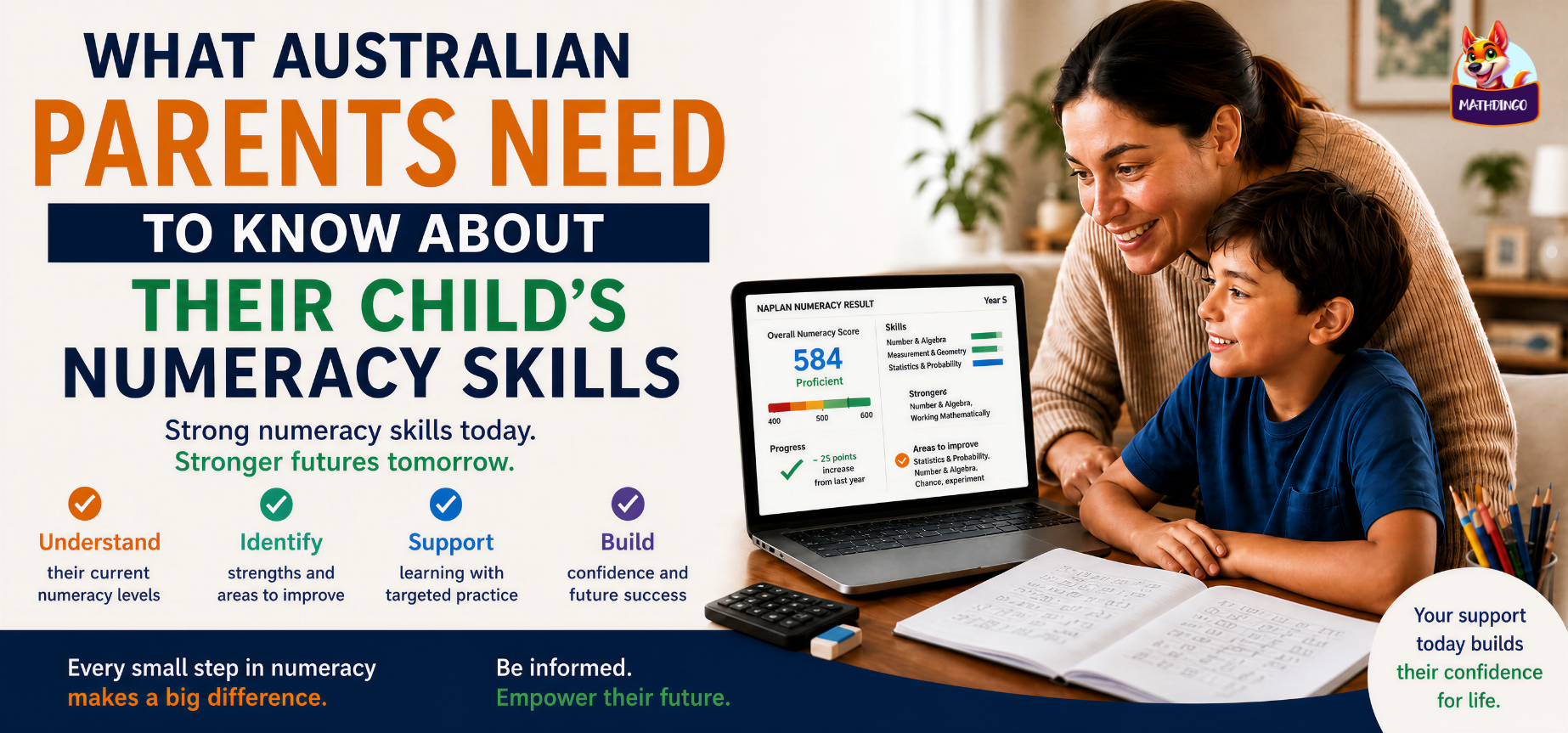
Your child’s NAPLAN results have arrived. Now what?
For many parents, the first reaction is to look at the result and wonder, “Is this good?” But a NAPLAN numeracy result can tell you much more than whether your child is above or below an expected level.
It can help you start a bigger conversation about how your child is progressing in maths, where they feel confident, and whether there are areas where they could use some extra support.
If you’ve recently received your child’s 2026 NAPLAN maths results, here’s what you need to know—and what you can do next.
What Is NAPLAN Numeracy?
NAPLAN, or the National Assessment Program – Literacy and Numeracy, is taken by students in Years 3, 5, 7, and 9 across Australia.
The numeracy assessment looks at how students use mathematical knowledge and skills to answer questions and solve problems. It covers areas such as:
- Number and algebra
- Measurement and geometry
- Statistics and probability
- Mathematical understanding
- Fluency
- Problem-solving
- Mathematical reasoning
So, NAPLAN maths isn’t simply about whether your child can perform a calculation correctly. It also considers how they apply mathematical knowledge and reason through different types of problems.
That distinction is important when you’re looking at your child’s result.
How Are 2026 NAPLAN Maths Results Reported?
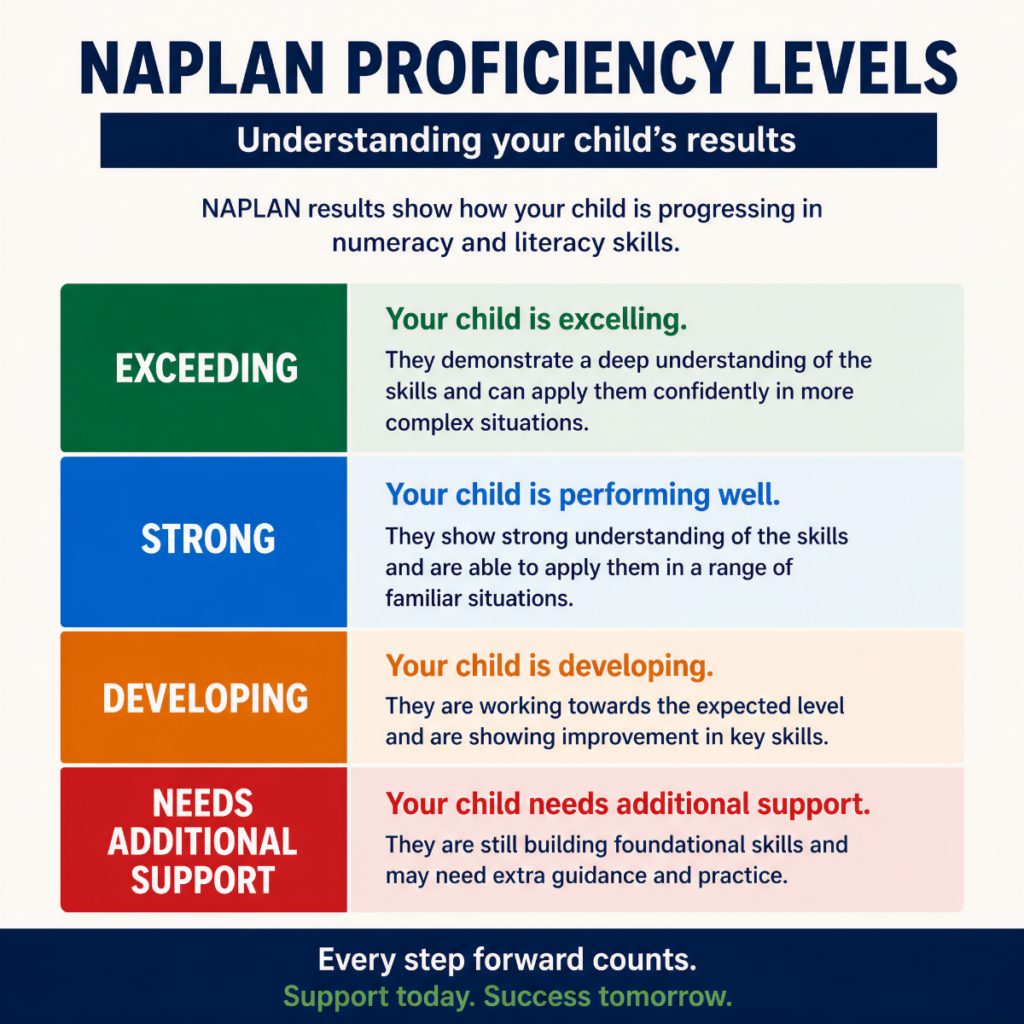
Since 2023, NAPLAN results have been reported using four proficiency levels:
Exceeding – The student is performing above the expected level for their year group.
Strong – The student is meeting challenging but reasonable expectations for their year level.
Developing – The student is working toward the expected level.
Needs Additional Support – The student may need additional support to progress satisfactorily.
If you see “Developing” or “Needs Additional Support” on your child’s report, it’s understandable to feel concerned. But try not to view the result as a label.
A single NAPLAN result cannot tell you everything about your child’s ability, potential, or attitude toward maths.
Instead, think of it as a snapshot of your child’s learning at a particular point in time.
The more useful question is:
What can this result tell me about where my child may need support?
The more useful question is:
What can this result tell me about where my child may need support?
One of the most common questions parents have is, “Is my child’s NAPLAN maths result good?”
There isn’t a simple yes-or-no answer.
Your child’s NAPLAN numeracy result makes more sense when you look at it alongside what you already know about their learning.
Consider things such as:
- How are they doing in their regular maths classes?
- What does their teacher say about their progress?
- Do they understand their homework?
- Can they explain how they arrived at an answer?
- Are there particular topics they avoid or find frustrating?
- Has their confidence in maths changed recently?
For example, a child may receive a solid overall result but still struggle with fractions or word problems. Another child may have a lower result but be making steady progress in the classroom.
That’s why it’s better to ask “Where does my child need help?” rather than simply “Is this a good score?”
Can NAPLAN Results Reveal Maths Learning Gaps?
NAPLAN provides useful information about numeracy achievement, but it isn’t designed to identify every individual maths difficulty your child may have.
A child can perform reasonably well overall and still have trouble with specific concepts, including:
- Fractions and decimals
- Multiplication and division
- Place value
- Percentages
- Word problems
- Measurement
- Geometry
- Algebra
- Data and graphs
- Mathematical reasoning
Sometimes the problem isn’t that a child “isn’t good at maths.” They may have missed an important concept earlier, and that missing piece is now making new topics harder.
Think about how maths builds from one concept to another.
A child who hasn’t developed a strong understanding of place value may later find decimals difficult. Trouble with fractions can make percentages and ratios more challenging.
Finding that missing piece can make a big difference.
What If Your Child Is Falling Behind in Maths?
If your child’s results suggest they may need some additional support, try not to panic.
Instead, take a step back and ask why maths has become difficult for them.
Maybe your child understands the concepts but struggles to apply them to word problems. Perhaps they need more time to process new ideas. Or they may have missed a foundational skill that their current lessons assume they already understand.
Confidence can also play a role.
After getting several maths questions wrong, a child may start thinking:
“I’m just not a maths person.”
Once that belief takes hold, they may become hesitant to participate, ask questions, or attempt problems they find challenging.
The right support can help them work through the underlying difficulty while rebuilding that confidence.
What Should Parents Do After Receiving the 2026 NAPLAN Maths Results?
If you’re wondering what to do after receiving your child’s NAPLAN results, start with a few simple steps.
1. Look at the bigger picture
Don’t judge your child’s maths ability based on one assessment. Consider their schoolwork, classroom performance, previous assessments, and overall progress.
2. Speak with their teacher
Your child’s teacher can help put the result into context and may be able to point out specific areas that deserve more attention.
3. Look for patterns
Pay attention to the types of questions or topics your child consistently struggles with. Is it multiplication? Fractions? Geometry? Word problems? Or is the main issue confidence?
4. Find out where the learning gap is
If you still aren’t sure what is causing the difficulty, a focused maths assessment can give you a clearer picture of your child’s current skills.
5. Choose support based on what your child actually needs
Once you know the problem, you can decide what type of support makes sense. That might mean additional practice, school-based support, personalized learning, or online maths tutoring. The important thing is to avoid guessing.
Understand the need first, then choose the support.
NAPLAN Maths Results vs. a Maths Assessment
Parents sometimes wonder why their child would need a maths assessment after already completing NAPLAN. The answer is that they serve different purposes.
NAPLAN gives a broad picture of student achievement in numeracy and helps parents and schools understand how a student is progressing against expected standards.
A focused maths assessment can take a closer look at the individual child’s current skills and areas of difficulty.
In simple terms:
NAPLAN asks:
How is my child progressing overall?
A focused maths assessment asks:
What does my child understand, and where are they struggling?
If you’ve looked at your child’s NAPLAN maths results and still don’t know exactly which concepts need attention, a more targeted assessment may give you the answers you’re looking for.
Can Online Maths Tutoring Help a Child Who Is Struggling?
Once you know where your child needs help, personalized learning can make the next step much more focused. Instead of spending time practicing everything, an online maths tutor can work with your child on the concepts they actually need to understand.
For example, the learning process might look like this:
Find the gap → Explain the concept → Practice together → Check understanding → Build confidence
One-on-one online tutoring can also give children more opportunities to ask questions and work through difficult concepts without feeling rushed.
And tutoring isn’t only for children who are falling behind. Students who are already doing well can also benefit from personalized support that challenges them to go further. The right approach depends on the child.
How Can Parents Help Improve Their Child’s Maths Skills?
You don’t have to turn every evening into a maths lesson.
A few simple habits can make a difference.
Encourage your child to explain their thinking
Instead of asking only, “What’s the answer?” try asking, “How did you work that out?” This helps you see whether your child understands the process or simply arrived at the right answer.
Make maths part of everyday life
Shopping, cooking, budgeting, time, measurements, and even board games can create natural opportunities to practice maths.
Don’t make mistakes feel like failure
Getting something wrong is part of learning. Encourage your child to look at the mistake and figure out what happened.
Focus on the right practice
More practice isn’t necessarily better. If your child has misunderstood a foundational concept, repeating the same type of question may only create more frustration.
Celebrate progress
When your child finally understands something they’ve been struggling with, recognize that progress. Small wins can go a long way toward rebuilding confidence.
FAQ About 2026 NAPLAN Maths Results
Your Child’s NAPLAN Result Is a Starting Point
Your child’s 2026 NAPLAN maths results can tell you something useful about their numeracy progress—but they don’t tell the whole story. If the result has left you with more questions than answers, that’s okay.
Start by talking with your child’s teacher. Look at the areas where they are doing well and pay attention to the concepts they find difficult. If you’re still unsure where the gaps are, a focused maths assessment can help you get a clearer picture. At MathDingo, our Free Maths Assessment is designed to help parents better understand their child’s current maths skills and identify areas where additional support may be useful.
Not sure where your child needs help?
Start with a Free Maths Assessment and get a clearer picture of your child’s maths skills.
Have a Question?
Leave your details below and our team will get back to you.