
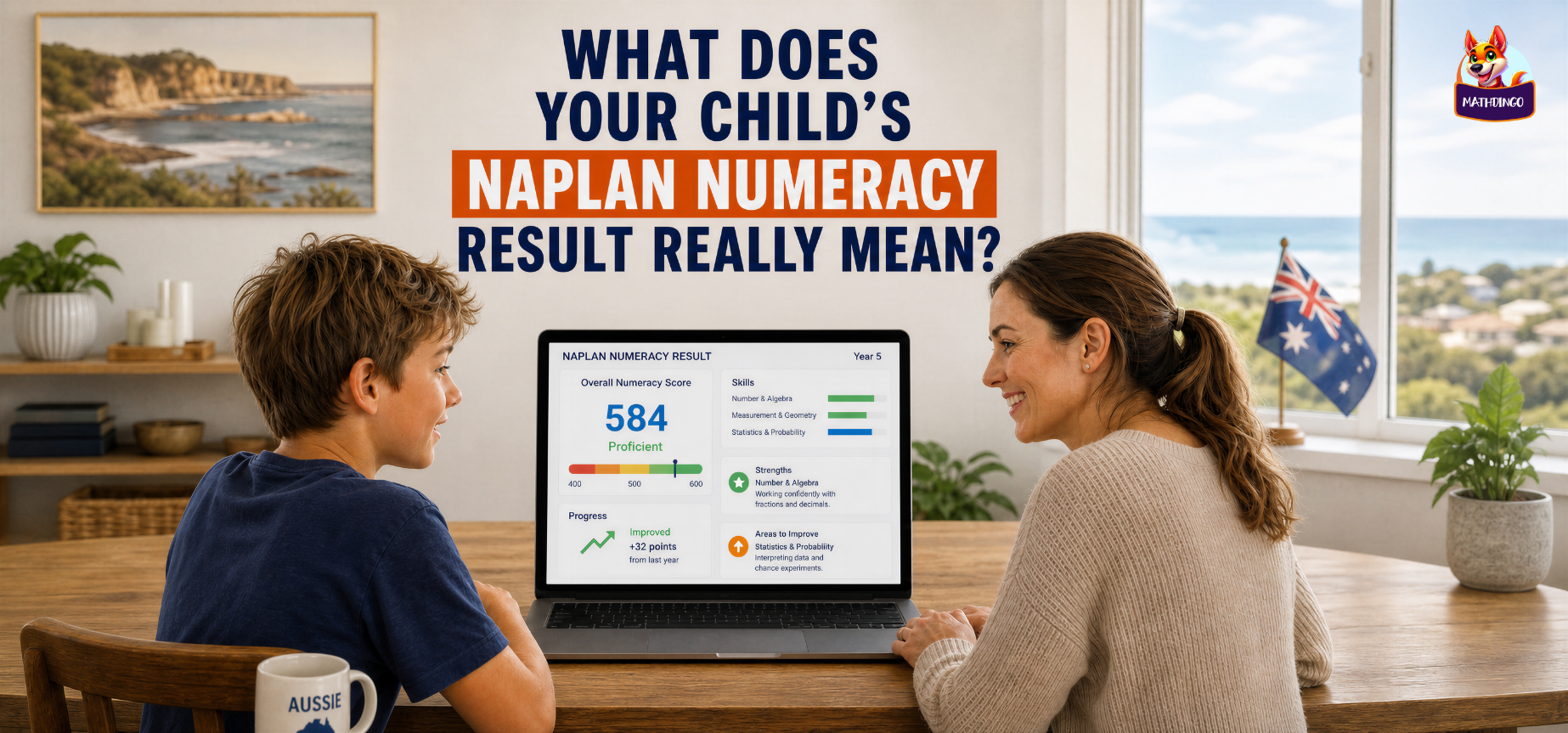
Your child’s NAPLAN numeracy result is here. You see the result, look at the proficiency level, and immediately start wondering: “Is my child doing okay in math?”
Before you worry—or start searching for extra tutoring—take a breath. One NAPLAN result doesn’t tell the whole story. It can show you how your child performed at the time of testing, but it doesn’t tell you everything about what they understand, where they may be struggling, or what they are capable of learning next.
The real question isn’t simply “Is my child’s result good or bad?” It’s “What can this result tell me about my child’s math learning?”
In this guide, we’ll break down what NAPLAN numeracy results actually mean, what different proficiency levels can tell you, why a result may not match classroom performance, and—most importantly—what you can do next to support your child.
What Does NAPLAN Numeracy Actually Measure?
NAPLAN numeracy is about much more than memorizing multiplication facts or getting quick answers.
The assessment covers mathematical skills and understanding across areas such as number and algebra, measurement and geometry, and statistics and probability. It also looks at how students apply their mathematical knowledge to solve problems.
That means a child might be comfortable with basic calculations but have difficulty when a question asks them to apply those skills in an unfamiliar situation.
So if your child struggles with a particular type of NAPLAN question, don’t immediately assume they are struggling with math as a whole. There may be a specific skill or concept that needs more attention.
How Is a NAPLAN Numeracy Result Reported?
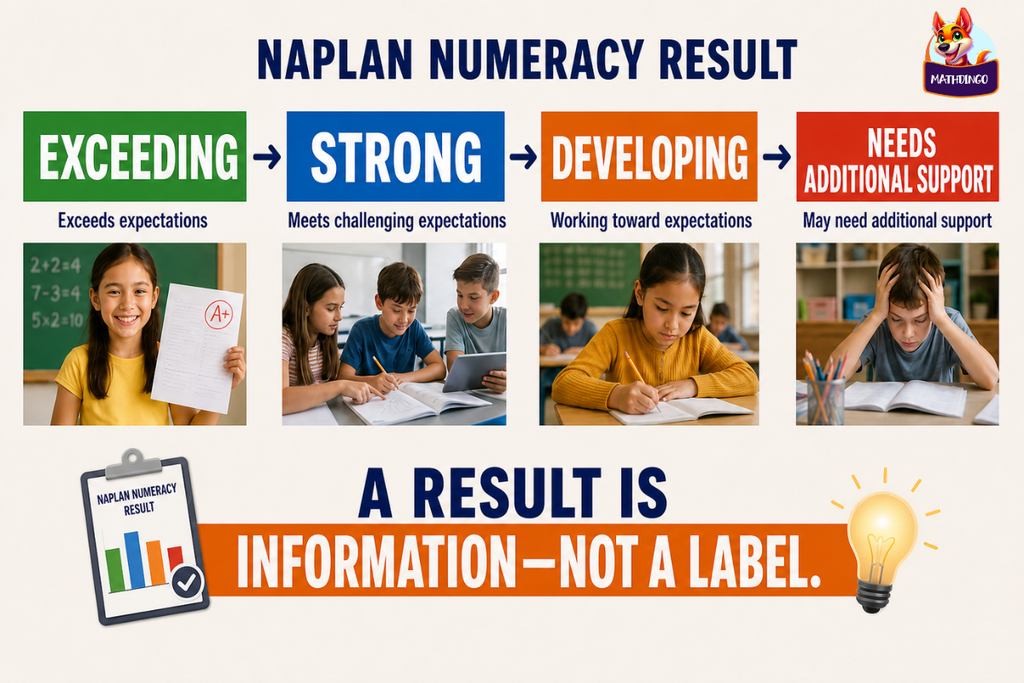
NAPLAN results are reported using four proficiency levels:
- Exceeding – the student’s result exceeds expectations at the time of testing.
- Strong – the student’s result meets challenging but reasonable expectations.
- Developing – the student is working toward expectations.
- Needs additional support – the student is not yet achieving the learning outcomes expected at the time of testing and is likely to need additional support.
These levels can give parents a clearer picture of where their child is performing.
But don’t think of them as simply “pass” or “fail.”
Instead, ask:
“What does this result tell me about what my child should work on next?”
That question can lead to a much more useful conversation about your child’s learning.
What Is a Good NAPLAN Numeracy Score?
There isn’t one magic NAPLAN result that makes a child “good at math.”
NAPLAN uses proficiency standards for each assessment area and year level. These standards represent challenging but reasonable expectations based mainly on what students have learned in previous years of schooling.
Your child’s report also provides context around their performance, which can help you understand how their achievement compares with other students in the same year level.
Still, try not to get too caught up in comparisons.
Your child’s math development is bigger than one result. Their classroom performance, teacher feedback, confidence and ability to apply concepts all matter.
What Does a Low NAPLAN Numeracy Result Mean?
First: don’t panic.
A result showing that your child needs additional support doesn’t mean they are “bad at math” or that they can’t improve.
Your child may have gaps in foundational skills. They might understand a concept when a teacher explains it but struggle to use it independently. They may find word problems difficult or have trouble applying familiar skills to unfamiliar questions.
The important thing is to find out what is causing the difficulty.
Instead of saying:
“You’re not good at math.”
Try:
“Let’s figure out which part of math is difficult and work on it together.”
That small change can help your child see math as a skill they can develop rather than something they either can or can’t do.
What Does a High NAPLAN Numeracy Result Mean?
If your child receives a Strong or Exceeding result, celebrate it!
A strong result can indicate that your child is demonstrating mathematical understanding and skills at or above the expected level at the time of testing.
But there’s still plenty of room to grow.
Encourage your child to explain how they solved a problem, look for different ways to reach an answer and tackle increasingly challenging problems.
The goal isn’t simply to keep chasing higher scores. It’s to build mathematical reasoning, curiosity and confidence.
Does NAPLAN Show Your Child’s Overall Math Ability?
No—not by itself.
NAPLAN is only one part of a child’s educational assessment. It reflects performance at a particular point in time and doesn’t capture every aspect of a child’s mathematical development.
For example, a child may understand a concept but struggle under test conditions. Another child may perform well on NAPLAN but still have specific areas where they need additional practice or greater challenge.
For a fuller picture, consider:
- NAPLAN results
- Classroom performance
- Teacher feedback
- Homework and other assessments
- Problem-solving ability
- Confidence with math
- Progress over time
Together, these can tell you much more than a single result.
Why Might NAPLAN Results and School Grades Differ?
You may notice that your child’s NAPLAN result doesn’t seem to match their usual classroom performance.
That’s not necessarily a problem.
NAPLAN is a standardized assessment taken at a particular point in time, while teachers see your child’s learning throughout the school year. Your child may also encounter questions in NAPLAN that are presented differently from the problems they usually solve in class.
That’s why NAPLAN results are best used as a starting point for discussion with your child’s teacher, rather than as a final judgment about their math ability.
How Can Parents Identify Their Child’s Math Learning Gaps?
This is where a NAPLAN result becomes especially useful.
You may know that your child needs support, but you may still be wondering:
“What exactly are they struggling with?”
Look for patterns.
Does your child struggle with fractions? Have difficulty understanding word problems? Find multiplication and division challenging? Make mistakes with measurements? Struggle to explain their reasoning?
A conversation with your child’s teacher can help identify areas that need attention.
A more personalized math assessment can also provide a clearer picture of your child’s strengths and areas that may need more practice, helping you focus on the skills that matter most.
How Can MathDingo’s Free Math Assessment Help?
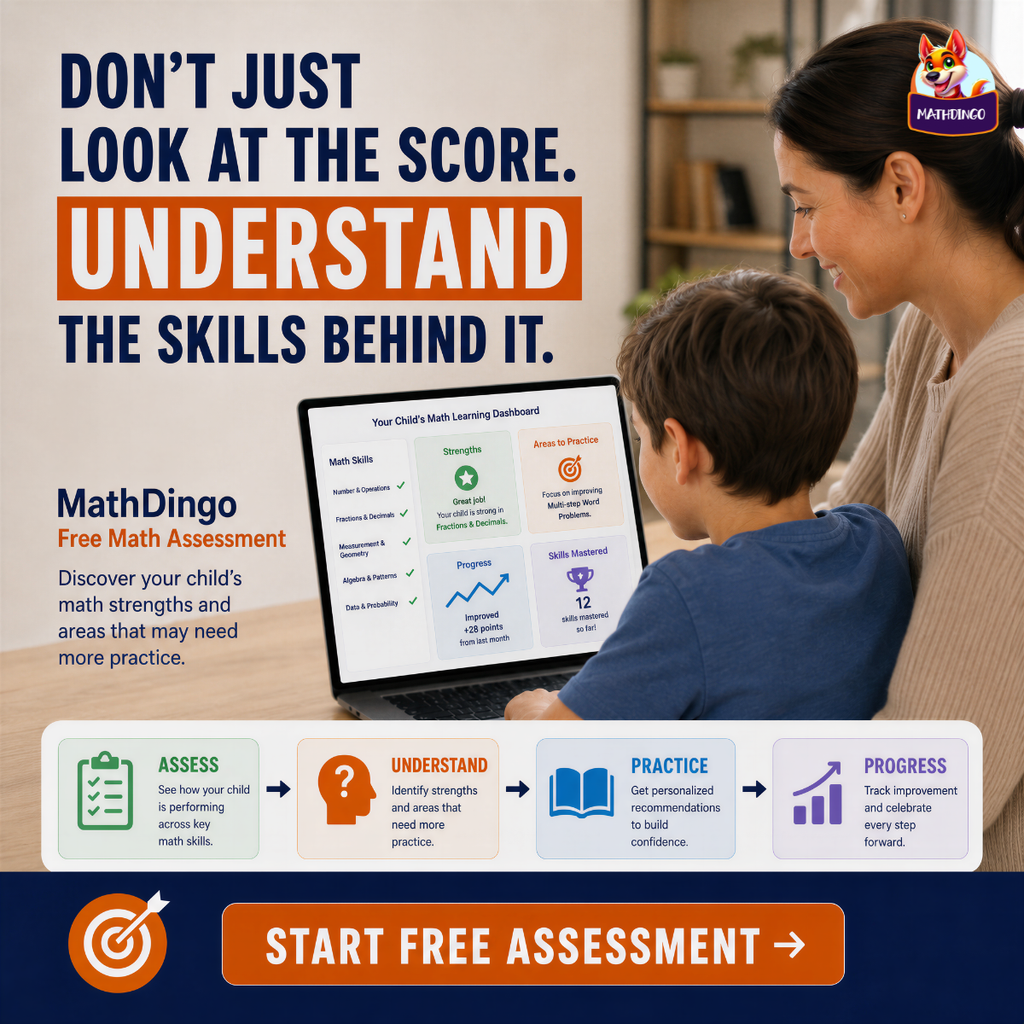
If you’re not sure where your child is struggling, MathDingo’s Free Math Assessment can be a useful first step.
Instead of guessing which topics your child should practice, an assessment can help give you a clearer picture of their current math skills and areas that may need attention. From there, parents can focus on more targeted practice rather than simply giving their child more worksheets.
MathDingo is designed for Australian students from Foundation through Year 9 and supports curriculum-aware math practice across skills such as number, operations, problem-solving, reasoning and fluency. Its parent experience also provides visibility into practice, accuracy, mastered skills and progress, helping parents better understand how their child is developing over time.
The goal isn’t to label your child. It’s to understand where they are today and figure out what they can work on next.
👉 Try MathDingo’s Free Math Assessment and get a clearer picture of your child’s math learning needs.
What Should Parents Do After Receiving a NAPLAN Result?
1. Don’t panic
Give yourself time to understand the result before drawing conclusions.
2. Look beyond the result
Consider teacher feedback and your child’s everyday classroom performance.
3. Identify specific skills
Instead of saying, “My child needs to improve at math,” try to identify the specific concepts causing difficulty.
4. Practice the right skills
Once you know the gap, focus practice on that area rather than giving your child endless worksheets.
5. Track progress
Look for improvement in understanding, independence and confidence—not just another test score.
How Can You Improve Your Child’s Numeracy Skills at Home?
You don’t need to turn your kitchen table into a classroom every night.
Everyday activities can become simple opportunities to practice math.
Try asking your child to:
- Work out prices while shopping.
- Measure ingredients while cooking.
- Calculate travel time or distance.
- Compare prices, quantities or measurements.
- Explain how they reached an answer.
- Find another way to solve the same problem.
You can also use age-appropriate math games and digital learning tools to make practice more engaging.
Most importantly, keep it short, regular and positive.
The goal isn’t to make your child feel like they’re constantly being tested. It’s to help them see math as something they can understand, practice and improve.
When Does a Child Need Extra Math Support?
Extra support may be worth considering if your child:
- Regularly struggles with basic math concepts.
- Avoids math homework or activities.
- Becomes frustrated when solving problems.
- Finds word problems particularly difficult.
- Continues struggling despite classroom practice.
- Has difficulty remembering concepts they previously learned.
The answer isn’t always “more practice.”
Sometimes the child needs the right practice.
Identifying the specific learning gap first can help you provide more focused and useful support.
FAQ
Have a Question?
Leave your details below and our team will get back to you.