
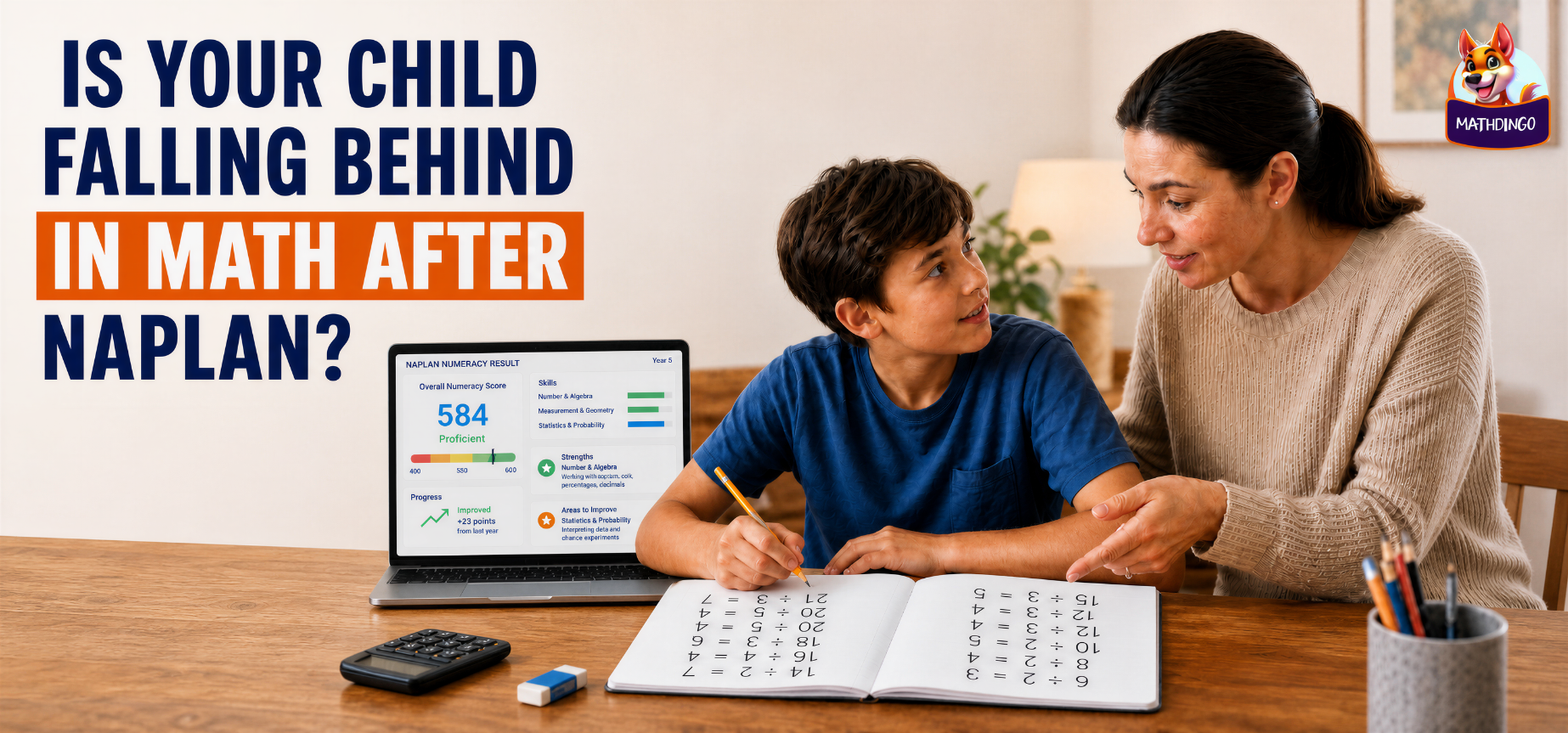
You get your child’s NAPLAN 2026 results and notice their numeracy result isn’t quite what you expected.
Maybe the report says Developing. Maybe it says Needs additional support. Or maybe the result has simply left you wondering whether your child is keeping up with the math skills they should be learning at school.
That’s when the questions usually start:
Is my child actually behind? Which parts of math are they struggling with? Should we be doing more practice at home? Do they need extra help?
It’s easy to worry when you see a result like this. But a NAPLAN result doesn’t tell you everything about your child’s ability or progress. It’s one piece of information that can help you understand where your child may need more attention.
So rather than focusing only on the score, start with a more useful question:
“What does my child already understand, where are they having difficulty, and what should we work on next?”
That’s what this guide is about. We’ll look at how to make sense of your child’s NAPLAN numeracy result, identify possible math learning gaps, talk with their teacher, and decide what kind of support could help—without turning math practice into another source of stress.
First, Understand What Your Child’s NAPLAN Result Means
NAPLAN results are reported using four proficiency levels:
- Exceeding – the student’s result exceeds expectations at the time of testing.
- Strong – the student’s result meets challenging but reasonable expectations.
- Developing – the student is working toward expectations.
- Needs additional support – the student is not yet achieving the learning outcomes expected at the time of testing and is likely to need additional support.
These aren’t simply labels for “good at math” or “bad at math.”
For example, a Developing result doesn’t mean your child can’t do math. It means they are working toward the expectations for their year level at the time of testing.
Likewise, Needs additional support doesn’t mean your child can’t catch up. It suggests that they may benefit from additional support.
That difference is important.
Does a Low NAPLAN Result Mean Your Child Is Falling Behind?
Not necessarily.
A lower result is a reason to look more closely, but it shouldn’t become a label that follows your child around.
NAPLAN is one snapshot of your child’s performance. Their teacher sees something much bigger: their classwork, participation, homework, progress and how they approach different types of math problems.
So take a step back and ask:
- How is my child doing in math class?
- What does their teacher think?
- Are they making progress?
- Which skills do they feel comfortable with?
- Where do they keep getting stuck?
- Have they started avoiding math or losing confidence?
You may discover that your child’s NAPLAN result matches what you’ve been seeing at home. Or you may find that your child is doing better in class than the result initially made you think.
One test can give you a clue. Your child’s overall learning gives you the bigger picture.
Find Out Where Your Child Is Actually Struggling
This is where you can start getting some real answers.
When someone says a child is “behind in math,” what does that actually mean?
Maybe multiplication facts aren’t secure. Maybe fractions are confusing. Maybe your child understands the calculation but can’t figure out which operation to use in a word problem.
Your child could be having trouble with:
- Number and place value
- Addition, subtraction, multiplication or division
- Fractions and decimals
- Measurement and geometry
- Word problems
- Algebraic thinking
- Data and probability
- Mathematical reasoning
NAPLAN numeracy covers areas such as number and algebra, measurement and geometry, and statistics and probability. So a child’s difficulty may go well beyond basic arithmetic.
Try to identify the specific problem.
Can your child solve a problem when you show them an example, but not when they’re working alone?
Do they know the steps but struggle to understand why they work?
Do they make the same mistake again and again?
These details are far more useful than simply saying, “My child needs to get better at math.”
Don’t give your child more math. Give them the right math.
Talk to Your Child’s Teacher
You don’t have to figure everything out on your own.
A quick conversation with your child’s teacher can give you valuable context around the NAPLAN result.
Instead of simply asking, “Is my child behind?”, try asking:
- “Which math skills is my child doing well with?”
- “Where are they having the most difficulty?”
- “Is this something you’ve noticed throughout the school year?”
- “Does their classroom work match what you see in the NAPLAN result?”
- “What should we focus on first?”
- “Is there anything we can practice at home?”
You might learn that your child needs help with one particular concept rather than math as a whole.
And that’s good news.
When you know what you’re dealing with, it’s much easier to make a useful plan.
Create a Simple Math Catch-Up Plan
Once you’ve identified a learning gap, don’t try to fix everything in one week.
A simple approach usually works better.
1. Start With One Skill
If your child struggles with multiplication, fractions and word problems, choose one to work on first.
Building one solid skill can make the next one easier.
2. Check the Foundation
Sometimes the problem isn’t the current topic.
For example, a child struggling with fractions may still be unsure about multiplication or division. Going back to those earlier skills isn’t going backward. You’re filling in a missing piece.
3. Keep Practice Short and Consistent
You don’t need marathon study sessions.
A little practice regularly can be much easier for a child to handle—and much easier for a parent to maintain.
4. Ask “How Did You Get That Answer?”
Getting the correct answer isn’t always enough.
Ask your child to explain how they worked it out. Their explanation can tell you whether they really understand the concept or are simply following a memorized process.
5. Notice Progress Beyond Test Scores
Maybe your child solves a problem independently for the first time.
Maybe they stop saying, “I can’t do this.”
Maybe they make fewer mistakes.
Those are wins, too.
Your goal isn’t to make your child catch up overnight. It’s to help them move forward, one skill at a time.Once you’ve identified a learning gap, don’t try to fix everything in one week.
A simple approach usually works better.
1. Start With One Skill
If your child struggles with multiplication, fractions and word problems, choose one to work on first.
Building one solid skill can make the next one easier.
2. Check the Foundation
Sometimes the problem isn’t the current topic.
For example, a child struggling with fractions may still be unsure about multiplication or division. Going back to those earlier skills isn’t going backward. You’re filling in a missing piece.
3. Keep Practice Short and Consistent
You don’t need marathon study sessions.
A little practice regularly can be much easier for a child to handle—and much easier for a parent to maintain.
4. Ask “How Did You Get That Answer?”
Getting the correct answer isn’t always enough.
Ask your child to explain how they worked it out. Their explanation can tell you whether they really understand the concept or are simply following a memorized process.
5. Notice Progress Beyond Test Scores
Maybe your child solves a problem independently for the first time.
Maybe they stop saying, “I can’t do this.”
Maybe they make fewer mistakes.
Those are wins, too.
Your goal isn’t to make your child catch up overnight. It’s to help them move forward, one skill at a time.
Make Math Practice Less Stressful at Home
Math doesn’t have to mean another worksheet at the kitchen table.
Look for opportunities in everyday life.
At the grocery store, ask your child to compare prices or figure out which product is the better value.
While cooking, talk about fractions, measurements and quantities.
On a road trip, talk about distance, time and estimates.
When watching sports, look at scores, averages and percentages.
Even games can create opportunities to talk about probability, patterns and strategy.
And try to keep the pressure low.
Avoid comparing your child with siblings or classmates. Don’t make mistakes feel like failures. Most importantly, avoid telling a child they’re simply “not a math person.”
Math skills can grow with practice, support and the right learning approach.
Sometimes, building confidence is part of building the skill.
How MathDingo’s Free Math Assessment Can Help
After looking at your child’s NAPLAN result, you may have a better idea that something needs attention—but you might still be wondering:
“Where exactly should we start?”
Maybe your child is struggling with fractions. Or perhaps multiplication is causing problems. It could even be that they understand the math but have difficulty applying it to word problems.
That’s where MathDingo’s Free Math Assessment can help.
The assessment gives you a clearer picture of your child’s current math skills, including areas they may already be comfortable with and areas where they may need more practice.
Instead of guessing which topics to focus on, you can use the results to make practice more targeted.
For example, rather than spending weeks reviewing math your child already understands, you can focus more attention on the skills that need strengthening.
And that can make a difference—not just in learning, but in confidence.
The goal isn’t to label your child or compare them with other students. It’s simply to help you answer an important question:
“What does my child need help with right now?”
Think of the assessment as a starting point, not a final judgment.
You can use what you learn alongside your child’s NAPLAN results, classroom performance and teacher feedback to decide what kind of support makes sense.
Find Out Where Your Child Needs Help
Don’t guess which math skills your child needs to practice. Find out where they are now and start from there.
Take MathDingo’s Free Math Assessment today and get a clearer picture of your child’s math strengths and learning gaps.
When Should You Consider Extra Math Support?
Not every child with a lower NAPLAN result needs a tutor.
But it may be worth looking at additional support if your child:
- Keeps struggling even with regular practice
- Has difficulty with basic or foundational math skills
- Is becoming increasingly frustrated with math
- Has started avoiding math homework
- Is losing confidence
- Needs more individual attention
- Understands concepts with help but struggles to apply them independently
The first step is figuring out what your child actually needs. Then you can choose the type of support that makes sense.
Sometimes that might be extra practice at home. Sometimes it’s support from a teacher. And sometimes a child benefits from more individualized tutoring or another learning resource.
FAQ
One NAPLAN Result Doesn’t Define Your Child
A NAPLAN result might raise a concern. But it doesn’t define your child’s ability, intelligence or future in math.
Instead of focusing only on the result, use it as a reason to ask better questions:
What does my child already understand?
Where are they getting stuck?
What should we work on first?
What kind of support would help?
You don’t have to solve everything at once.
Understand the result → Find the gap → Practice the right skill → Track progress
That’s a much more useful path forward than simply giving your child more worksheets or putting more pressure on them.
Your child doesn’t need to feel like they’re “bad at math.”
They need the right support, the right practice and the confidence to keep going.
Ready to find out where your child needs help?
Try MathDingo’s Free Math Assessment and get a clearer picture of your child’s math strengths and areas to work on.
Have a Question?
Leave your details below and our team will get back to you.