
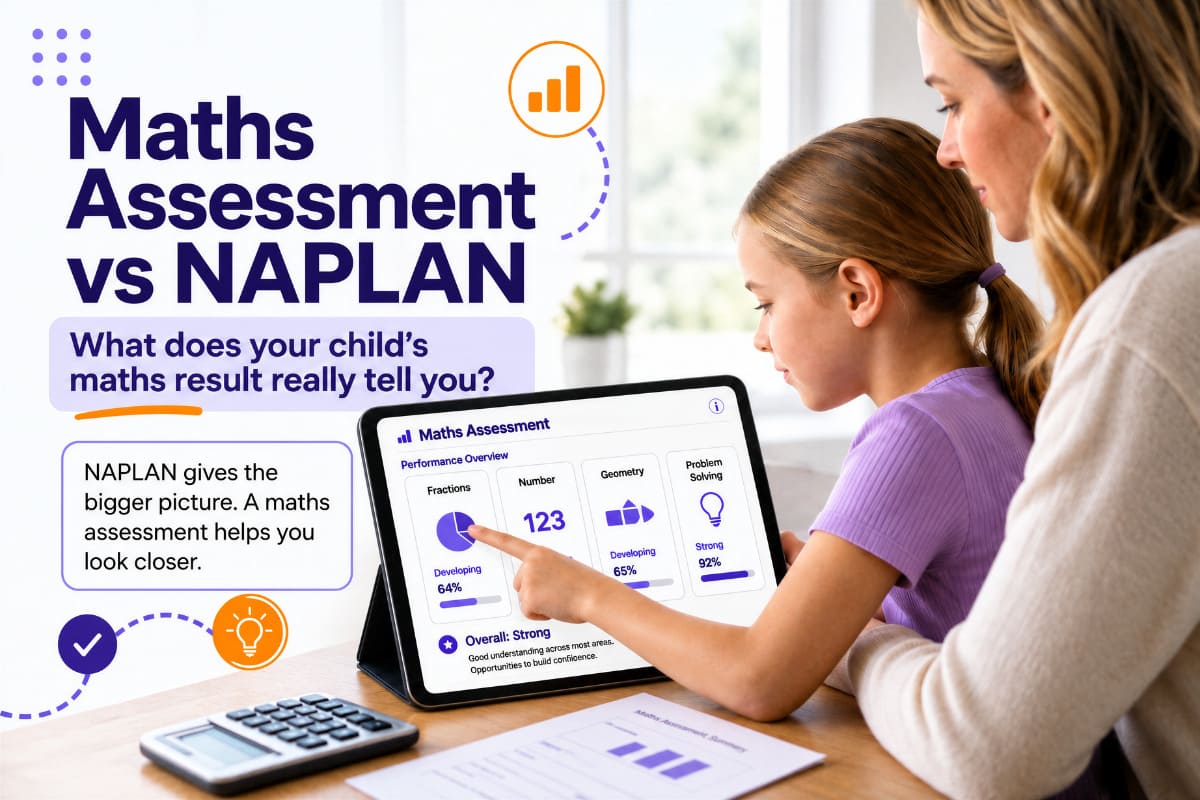
Your child’s NAPLAN results have arrived. You look at the numeracy score and think, “Is my child really doing okay in math?”
Maybe the result is lower than you expected. Or perhaps it’s perfectly fine, but your child still struggles with fractions, multiplication, or math homework at home.
So what does the NAPLAN result actually tell you?
And more importantly, does it tell you what your child should work on next?
Not necessarily.
NAPLAN can give you a valuable snapshot of your child’s numeracy achievement, but it isn’t designed to show every math skill they have mastered or every area where they may need support.
That’s where a dedicated maths assessment can provide another piece of the puzzle.
In this guide, we’ll explain the difference between NAPLAN and a maths assessment, when an additional assessment may be useful, and how you can use the information to make your child’s math learning more focused and effective.
NAPLAN vs Maths Assessment: At a Glance
NAPLAN: Provides information about a student’s literacy and numeracy achievement through a national assessment program.
Maths assessment: Focuses specifically on mathematical skills and can help identify areas of strength and potential learning gaps.
Does your child need both? Not necessarily. But they can provide different information that complements the overall picture of your child’s learning.
What Is NAPLAN?
NAPLAN stands for the National Assessment Program – Literacy and Numeracy. Students in Years 3, 5, 7, and 9 participate in NAPLAN in Australia.
The numeracy assessment covers areas of mathematics including number and algebra, measurement and geometry, statistics and probability, as well as mathematical understanding, fluency, and problem-solving.
For parents, NAPLAN can be a useful way to understand their child’s numeracy achievement within a national assessment framework.
But there is an important distinction:
NAPLAN is not a complete report card on your child’s math ability.
Teachers also use classroom work, observations, assignments, and other assessments to understand how an individual student is progressing.
What Is a Maths Assessment?
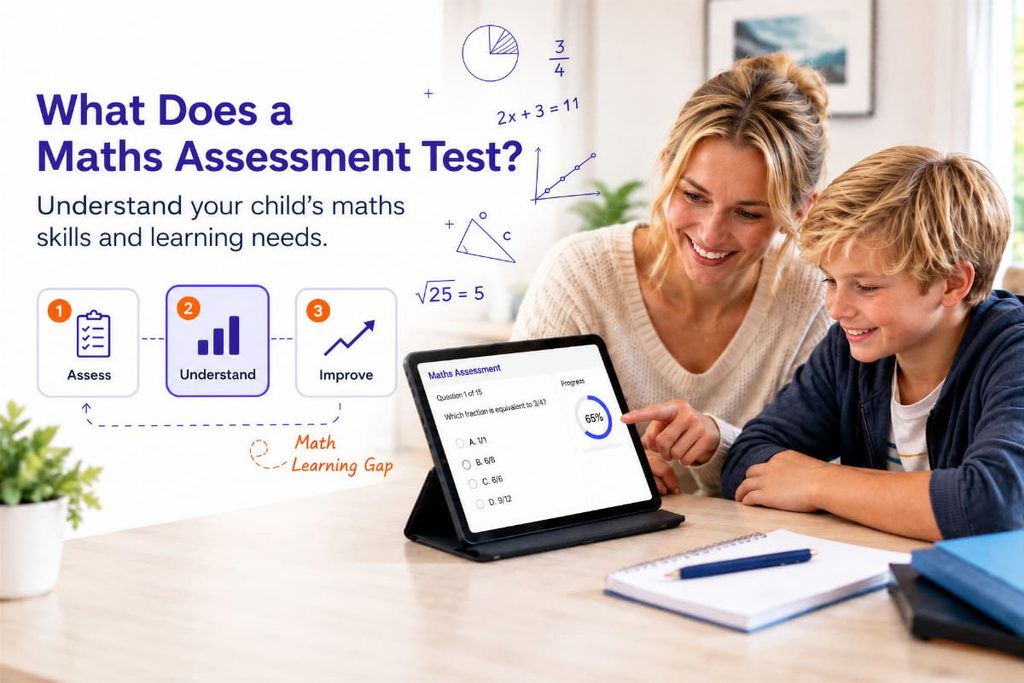
A dedicated maths assessment takes a closer look at your child’s mathematical skills.
Think of it as zooming in.
Instead of looking only at overall performance, a maths assessment can examine individual concepts such as:
- Number and place value
- Multiplication and division
- Fractions and decimals
- Measurement
- Geometry
- Patterns and algebra
- Problem-solving and reasoning
The most useful question isn’t simply, “What score did my child get?”
It’s:
“What does my child understand, and what should they work on next?”
That information can make math practice much more targeted.
Can a Child Do Well on NAPLAN and Still Have Maths Gaps?
Yes.
Math isn’t one single skill. It is a collection of concepts that build on one another.
Imagine a Year 5 student who is confident with multiplication and division but struggles with fractions. Their overall numeracy performance may look quite different from their performance on a specific fractions assessment.
Or consider a Year 7 student who can perform calculations accurately but finds multi-step word problems difficult. They may understand the calculations but struggle to decide which steps to take.
These differences matter.
A child can perform well overall while still having specific areas that need attention.
That’s why parents shouldn’t assume that a strong NAPLAN result means their child has mastered every math concept—or that a lower result means they are struggling with everything.
Maths Assessment vs NAPLAN: What’s the Difference?
The simplest way to think about the difference is:
NAPLAN provides a broader view of numeracy achievement. A maths assessment provides a closer look at individual maths skills.
| NAPLAN | Maths Assessment | |
| Main purpose | Measure broader student achievement | Examine individual maths skills |
| Focus | Literacy and numeracy | Mathematics |
| Timing | Conducted during the NAPLAN assessment period | Can be completed when needed |
| Results | Provides broader achievement information | Can highlight strengths and areas for development |
| Use for learning | Helps inform understanding of achievement | Can help guide targeted practice |
Neither assessment is necessarily better.They simply answer different questions.
NAPLAN asks, in broad terms, “How is this student performing?”
A focused maths assessment can help answer:
“Which maths skills are strong, and which ones may need more work?”
When Should Your Child Take a Maths Assessment?
You don’t have to wait for a NAPLAN result to assess your child’s math skills.
An additional assessment may be worth considering if:
- Your child regularly struggles with math homework.
- They find particular topics frustrating.
- Their teacher has raised concerns about their progress.
- They have lost confidence in math.
- You’re unsure which skills they should practice.
- Their NAPLAN numeracy result was lower than expected.
- You want to know whether they’re ready for more advanced work.
It can also be useful for children who are doing well.
If your child finishes schoolwork quickly and enjoys math, an assessment may help identify areas where they are ready for greater challenge.
The goal isn’t to test children simply for the sake of testing.The goal is to use assessment information to make learning more useful.
What Should You Do After Your Child’s NAPLAN Results?
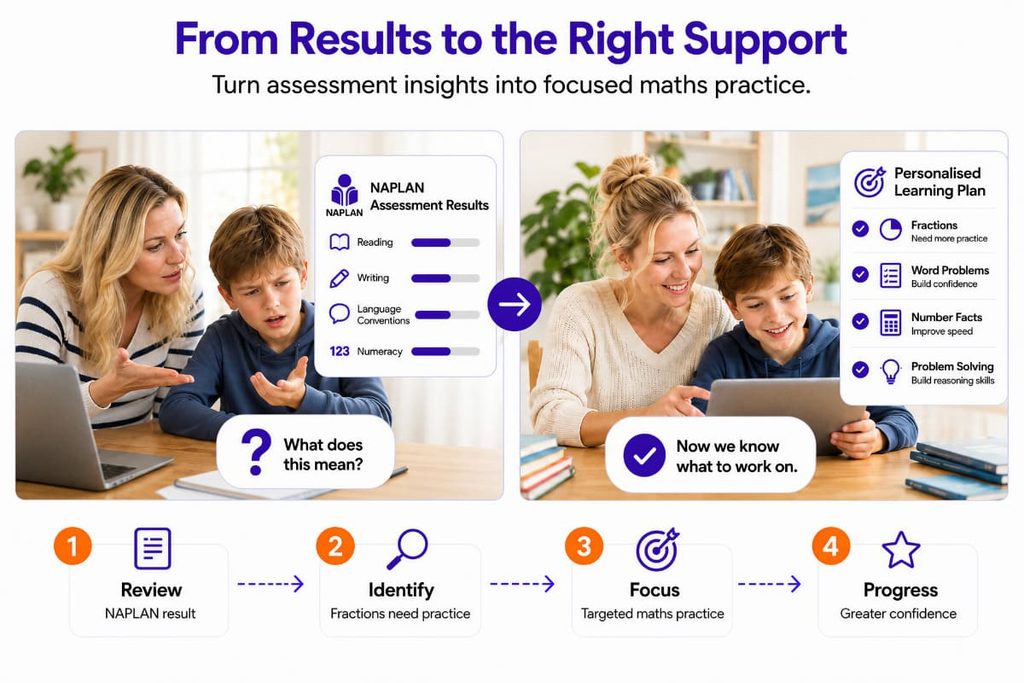
If you’re concerned about your child’s numeracy result, don’t immediately reach for a pile of extra worksheets.
Start with a better question:
“What specific skill needs attention?”
A practical approach is:
Review the result → Identify concerns → Assess specific skills → Find potential learning gaps → Target practice → Monitor progress
For example, if your child is struggling with fractions, targeted fraction practice may be more useful than repeating math topics they already understand.
This can also help protect your child’s confidence.
Instead of thinking:
“I’m bad at math.”
They can begin to think:
“Fractions are difficult for me right now, but I know what I need to practice.”
That’s a much healthier starting point for learning.
Want to Know What Your Child Should Work on Next?
If you’re still asking, “Okay, but where does my child need help?”, a dedicated maths assessment can be a useful starting point.
MathDingo’s Free Maths Assessment is designed to help Australian families get a clearer picture of their child’s current maths skills and potential areas for improvement.
Rather than waiting until the next major assessment, you can start exploring your child’s skills now.
Find Out Where Your Child Stands in Maths
Take the free MathDingo assessment to better understand your child’s maths strengths and potential learning gaps.
Frequently Asked Questions
NAPLAN includes a numeracy assessment, but it is part of a broader national assessment program. It provides information about numeracy achievement rather than a complete profile of every math skill.
NAPLAN numeracy covers a range of mathematical knowledge and skills, but it should not be viewed as a complete assessment of everything a child knows or can do in mathematics.
Yes. A child may perform well overall while still finding particular concepts, such as fractions, algebra, or problem-solving, difficult.
Start by looking for more information about your child’s individual skills. A focused maths assessment may help identify areas that could benefit from additional practice or support.
It depends on your child’s needs. If you’re concerned about their progress, confidence, or specific math skills, an additional assessment can provide useful insight.
Yes. A strong NAPLAN result doesn’t necessarily mean your child has mastered every math concept. An individual assessment can highlight strengths and areas where they may be ready for additional challenge.
The Bottom Line
NAPLAN and maths assessments aren’t competing tests. They give you different pieces of the puzzle. NAPLAN can help you understand your child’s broader numeracy achievement. A dedicated maths assessment can help you look more closely at their individual skills and potential learning gaps.
So when you look at your child’s NAPLAN result, don’t stop at the score. Ask the more useful question:
“What can I do next to help my child become a more confident math learner?” If you’re not sure where to begin, start by understanding where your child’s maths skills stand. Take MathDingo’s Free Maths Assessment today.
Have a Question?
Leave your details below and our team will get back to you.